|
JUPITER JAN-FEB 2016 By Christopher Go JUNO will arrive in Jupiter this coming July! All images were taken using a Celestron C14 mounted on an Astrophysics AP900GTO mount. I used a Celestron Skyris 236M camera. RGB is done using a set of Chroma Technology RGB filters on a Starlight Xpress Motorized filter wheel. Methane band images are done using a Chroma Methane Band filter (889nm 18nm bandpass). UV images are done using a Astrodon UV filter. Amplification is done using an Astrophysics Convertible Barlow working at 2.0X. Image acquisition was done using Torsten Edelmann's Firecapture 2.5beta 64bit software. All images are NORTH UP! The Skyris 236M camera is controlled by a Thinkpad T530 through the USB 3.0 port. Processing was done using AutoStakkert! and Registax. These images were taken at Banilad, Cebu City, Philippines. For more information on the names of various belts and zones of Jupiter and the meaning of the abbreviations I use please check the Sky and Telescope Jupiter Observing Guide. All images of this site are my property. If you wish to publish it on your site or print, please email me for permission. |
CelestronC14! My old images can be viewed at:
|
| February
28, 2016
Seeing was very challenging today because of the cold front. I had to use a lot of data to get some decent images. Oval BA is well resolved. The SEB continues to have complex activity on it's edges. The NEB looks quiet in this region.
|
|
| Red Oval BA 10th
Anniversary! Here is a high resolution image of Jupiter's Red Oval BA aka Red Spot Jr. I used close to 40min of data which was derotated then deprojected using Winjupos!
|
| February
23, 2016
10 years ago on February 24, 2006 (Feb 25 Philippine Time), I was late in imaging Jupiter because I overslept. This was fortuitous because I was able to the first image of the red Oval BA rising on Jupiter's disk. 10 year later, my little red spot is still red! Seeing was excellent this morning except for 20 min when Oval BA was at the CM during which time seeing suddenly turned very bad. Oval BA still has a dark red ring. Note the complex feature following Oval BA. The SEBs is very active due to the wake of the GRS. The NEB has a very dark red color with a lot of rift activity.
|
|
| February
20, 2016
I had a very frustrating imaging session today. The sky was clear but we had some turbulence so I started taking the methane band images. After taking the methane band image, the sky was overcast. I had to wait for almost half an hour before I had a small break to capture some RGB. Then it was overcast again. I was able to give up after waiting for more than half an hour. I'm glad I waited. The GRS is well resolved. It has a very strong red color. Note the dark features overflowing from the GRS. Note that there are no outbreaks in the wake following the GRS. SEBn is also losing color! Is a fade starting? White Spot Z is very prominent on the NEBn. The region following this spot is wider than the region preceding it. The South Polar red spot can also be seen below the GRS. Now here is the reason I'm glad I was patient this evening. Note the small reddish (DS5) spot embedding on the STB Spectre!! DS5 has faded a lot!
|
|
| February
12, 2016
Condition was still variable today. The GRS is rising on this in this images. The GRS still has a strong color. There are a lot of rift activity on the NEB. The NTB is active in this region. The bluish STB ghost is also very prominent.
|
|
| February
11, 2016
Seeing was variable this evening due to northernly winds. Note the dark red barge on the SEB at the CM of the second image. This feature is still very prominent months after its merger. The NEB looks quiet in this region and it's very narrow here.
|
|
| February
8, 2016
Condition was a bit challenging this morning. We are still having a monsoon is still affecting seeing here. Oval BA is well resolved. Io can be seen on the NEB. Io's shadow is distorted due to effects of derotation. Io was added to the image by using the best image of the batch. The original image had Io distorted due to derotation.
|
|
| February
6, 2016
Condition was variable this evening. Seeing started very bad but improved as Jupiter got higher. Oval BA can be seen these images. The red ring is prominent. The NEB has a lot of rift activity. The SEBn looks very complex.
|
|
| February
2, 2016
It was raining all night but it cleared around midnight. Seeing was good but it was very windy. Humidity was high and I had to use my dew shield which made imaging a challenge because it made the wind induced shaking worse. The NTB is active in this region. Note the small ovals lining up. The NEB has a lot of rift activity. The NEB is narrow in this region. The STB ghost is prominent.
|
|
| January
30, 2016
After over a week of bad weather because of a cold front, I finally got a clearing. Seeing was perfect today. But transparency was variable due to dew. Oval BA is well resolved. The orange ring is very prominent. Part of the SEBn has the light colored features. The large red dark barge on the SEBs is still prominent on the left of the 2nd image. Note the two dark red ovals on the NEB looks very interesting as they seem to be interacting with each other. The NTB is rather quiet in this region. The CH4 bright spot on the NNTB seems to be a low contrast white spot on the visible light image.
|
|
| January
23, 2016
Condition was terrible today. I had to use 20min worth of data and rejected half that to get the color image. That is why the image of Io and it's shadow seemed distorted. I also added in the image of Io to this image. The SEB is quiet in this region. The NEB has an outbreak close to the shadow of Io.
|
![]() |
| January
22, 2016
It was cloudy during the last few days. Fortunately it cleared up today. Seeing was excellent! Hre is an image of Jupiter with the red Oval BA. Next month, it will be the 10th anniversary of my discovery of when this spot turned red! After 10 years, the red ring of Oval BA is still prominent! Note the two small ovals following BA. Note the SEBn where you have the bright light yellow features lining up. The NEB has a strong dark color and has a lot of rifts. Sadly, my Methane band image got corrupted during image acquisition.
|
|
| January
18, 2016
Seeing was variable today. With periods of excellent seeing, but with periods of mucky seeing. Note the three large ovals forming a triangle in the NNTB. The bright one on top is bright in CH4 so it must be an anti-cyclone. There are tiny ovals on the NTB. The NEB has a lot of complex rift activity. Note the bright features on the SEBn. Note that the two dark spots on the SSTZ have merged!!
|
|
| January
17, 2016
Condition was fantastic today! Seeing was very stable. Oval BA is rising on the left. The white core is well resolved. The SEBs is very active in this region. The NEB has a lot of outbreaks and complex rifts. The NTB is quiet in this region.
|
|
| January
16, 2016
Had a frustrating imaging session. Intermittent clouds were bothersome this morning. Seeing was also very unstable. The GRS is very well resolved in these images. Note the dark edge especially on the upper right side of the GRS. The NEB is active in this region. Note the two ovals forming a dumbell at the NTB.
|
|
| January
15, 2016
Overslept this morning. Jupiter was way past the meridian. Seeing was unstable because of clouds. Note the three large white ovals on the NTZ close to the CM. The wake of the left most spot seem to be the one creating the reddish wake on the NTZ. The outbreak on the NEB is creating complex rifts. The SEB has a light color compared to the NEB. Note the dark oval on the SEBs.
|
|
| January 2016
II:120 Animation Here is an animation with date from Jan 6, 11 and 13.
|
| January
13, 2016
Seeing was again average this morning. Fortunately, the sky was perfectly clear. The NEB has lot of bright complex rifts. The NTB is also very active in this region. The SEB has notable a lighter color vs the NEB. Note the two very small dark spots on the SSTZ. These two spots have been getting closer and closer especially if you compare from my image 2 days ago. Seems like these two will merge soon.
|
|
| January
12, 2016
Condition was average this evening. I had to also deal with passing clouds. The GRS is setting on these images. Note the complex wake of the GRS. Note also the South Polar Red Spot which is very prominent in these images. The NEB is wide in this region. The White Spot Z is surrounded by reddish material but the spot itself is still white. This spot is slightly bright in methane band.
|
|
| January
11, 2016
Seeing and transparency was close to perfect today! The blue STB ghost is prominent in this image. The SEB seems to be lightening in color. Except for the dark features on the SEBs and SEBn, the belt seems to be light especially compared to the very dark NEB. The NEB is narrow in this rgeion. The NTB is very active here. Are those small bright spots the cause of the darkening of this belt?
|
|
| January
8, 2016
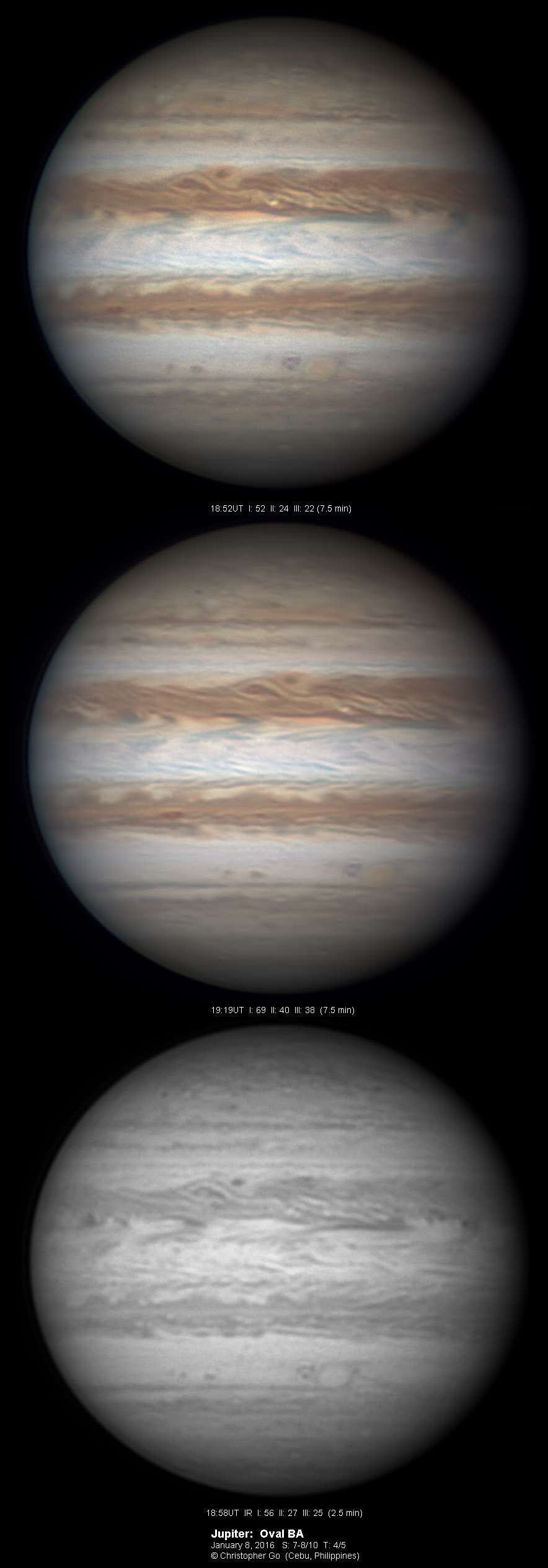
Condition was variable this evening. Not as good as two days ago. The NEB is very active in this region with a lot of complex rift and an outbreak. Note the dark spot at the NEBn. The SEBn has an interesting white wave features. Note the dark red spot on the SEBn. It is very elongated. Oval BA has a very light orange color with its surrounding area basically white!
|
|
| January
6, 2016
I got the best seeing this season this morning! Lots of activity this morning. The NEB is very active in this region. Lots of distorted ovals. Note the reddish/white stream on the NTBn which seem to emanate from a dark oval on the NTBn. The NEB is very choatic with complex rifts. Note the interesting feature on the SEBn. These large white blobs lining up on the SEBn that seem to be created by feature just past the CM on the first image.
|
|
| January
4, 2016
Condition was perfect this morning! I have finally been able to capture an excellent image of the GRS! The GRS has a strong red color. Note teh dark core of the GRS. There are also what seems to be 2 smaller ovals inside the edges of the GRS! I did not do any deprojection on the image of the GRS below. The SSTB spots are it's surrounding area are well resolved. The NEB has a lot of rift activity. Note the long white stream on the NEBn beginning at the CM towards the right.
|
|
| January
2, 2016
Condition was variable this morning. Unfortunately, my imaging run was cut short because clouds rolled in. The GRS has very strong color. The NEB is narrow in this region.
|
|
| January 1, 2016
Condition was very poor this morning. Seeing and transparency was unstable due to gusty winds and clouds. The NEB is very active past the CM. My image of this region is much clearer yesterday. The dark red spot is prominent on the mid-SEB. Ganymede can be seen on the lower right and Io can be seen peeking out on the SEB on the left.
|
|
Copyright 2016 Christopher Go (chris@cstoneind.com)